

Welcome, AI & Semiconductor Investors,
Today’s three stories follow the infrastructure buildout from chip supply to connectivity to financing. AMD is preparing to deliver more CPUs and GPUs in 2027. Marvell has raised its outlook again, with networking doing the work behind the latest increase. And SpaceX is reportedly arranging about $40 billion to buy NVIDIA chips.
The connection is useful: more ambitious AI systems require capacity across the supply chain, connections between that compute, and capital to put it to work. Each story gives us a different way to follow that expansion and a different milestone to measure next.
What The Chip Happened?
AMD: Lisa Su plans a substantial supply increase for 2027.
Marvell: A second raise takes the FY2028 revenue outlook to about $20 billion.
SpaceX: Reported $40 billion NVIDIA-chip financing brings the funding requirement into focus.
Read time: 7 minutes
33% Off What I Believe Is The Greatest Semiconductor & AI Investing Community!!
AMD ($AMD) : More supply for a bigger 2027 opportunity
What The Chip: Lisa Su told Reuters today that AMD plans to substantially increase chip supply in 2027. Her Taiwan visit is focused on expanding CPU and GPU production, and the demand she sees over the next several years requires more advanced wafer capacity.
That puts a physical supply plan alongside the growth AMD outlined in August. CPUs and accelerators are both part of the opportunity. On the earnings call, Su described work across wafers, back-end manufacturing, substrates and other components after server demand accelerated. Capacity at one stage needs the rest of that chain to support it.
Details:
At the August 4 earnings call, Su expected server-CPU revenue to grow more than 70% in 2027, off a higher base, and total data-center revenue to more than double. Helios and MI450 deployments are central to the accelerator ramp.
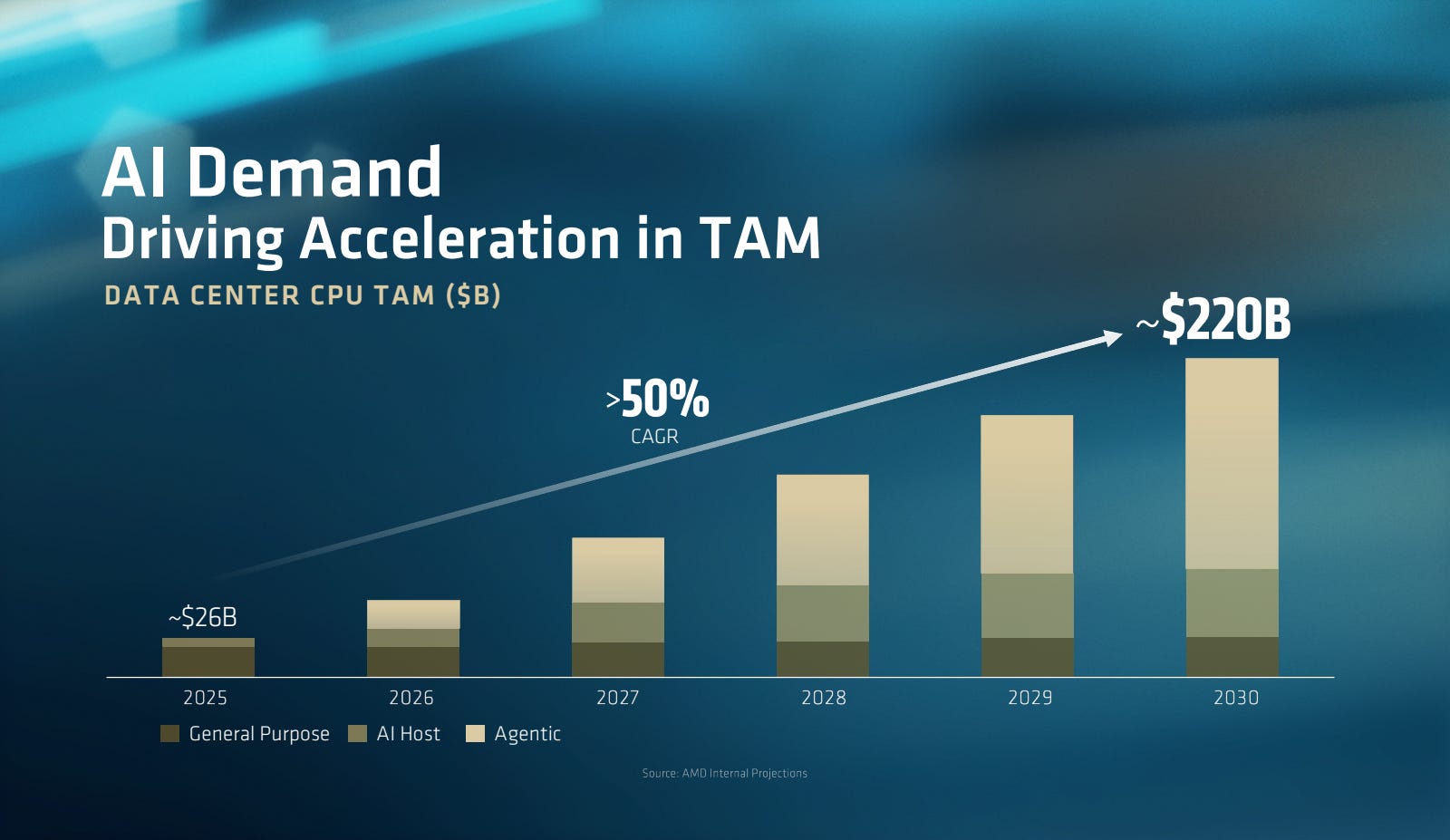
AMD’s forecast for the industry CPU market has expanded substantially: approximately $60 billion for 2030 at the November 2025 Financial Analyst Day became approximately $220 billion for the same 2030 horizon at July’s AI event.
Su said in August that agentic sandboxes, the smallest part of that CPU opportunity today, could become its largest part over the coming years.
Why AI/Semiconductor Investors Should Care: The CPU expansion is an agentic-AI story. Models still need GPUs, while agents create CPU work through tool calls, code execution, sandboxing, and orchestration. Both sides can grow together. That has been the CPU thesis from Lisa Su and other semiconductor CEO, and today’s supply plan gives it an operational development to follow.
The next part is delivery. AMD’s 2027 expectations depend on bringing the broader supply chain and customer deployments together. A larger forecast market explains the opportunity; the CPU revenue growth and Helios ramp will show how much of it reaches AMD’s business.
Marvell ($MRVL) : Connectivity powers another revenue-outlook raise
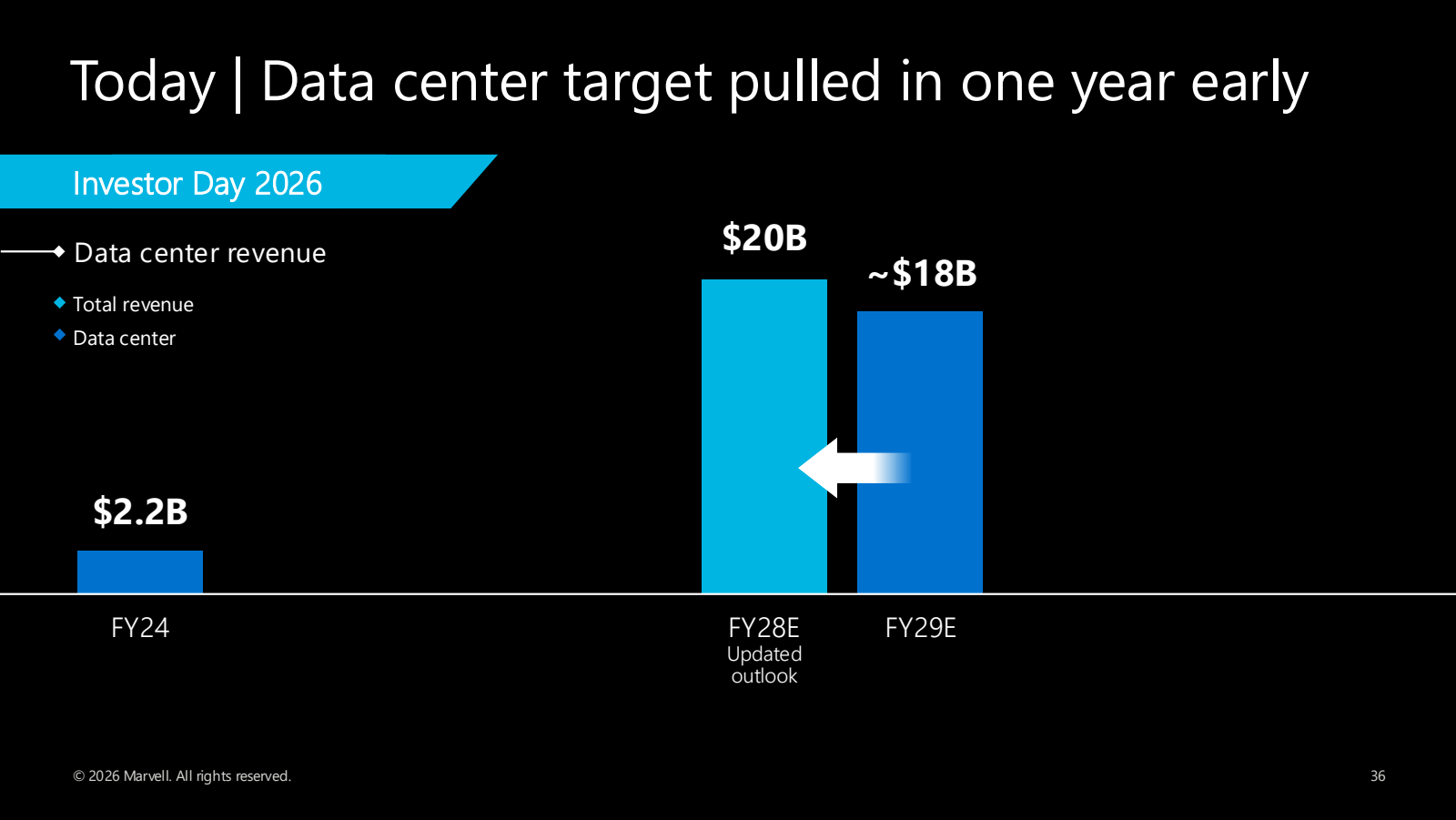
What The Chip: Marvell raised its FY2028 revenue outlook to about $20 billion at today’s Investor Day. That follows the $18 billion outlook issued in August, which was itself an increase from $16.5 billion one quarter earlier. The company has now raised the same fiscal-year outlook twice.
The driver matters as much as the headline. Management attributed the latest $2 billion increase to scale-out optics, scale-up optics and switching. These are the connections that let expanding AI systems move data between compute resources, and they were also behind August’s increase.
Details:
Marvell now forecasts about $18 billion of data-center revenue in FY2028. Murphy said that would reach the target previously set for FY2029 almost a full year early.
Custom silicon has its own upgrade: the FY2029 target is now more than $12 billion, versus the earlier $10 billion-plus target. Both figures are minimum targets.
The new FY2031 long-term model targets $70–90 billion in total revenue. Its assumptions imply non-GAAP EPS above $30 at the revenue midpoint.
Why AI/Semiconductor Investors Should Care: Marvell gives investors exposure to several parts of the AI buildout, with connectivity contributing alongside custom silicon. Today’s nearer-term upgrade helps explain that breadth: the outlook is moving because optics and switching are expanding, even before treating every custom opportunity as realized revenue.
The nearer FY2028 forecast and longer FY2031 model should be followed on their own horizons. Revenue mix also matters to the earnings path: CFO Dan Durn said stronger connectivity performance would tend to push gross margin toward the upper end of the model’s range. Tracking which businesses deliver the growth will make the forecast more useful than watching the headline alone.
SpaceX ($SPCX) / NVIDIA ($NVDA) : A reported $40 billion financing plan for NVIDIA chips
What The Chip: SpaceX is seeking about $40 billion to buy NVIDIA chips, the Financial Times reports. Apollo is expected to lead roughly $10 billion in bank loans and $30 billion in investment-grade debt, with closing expected in 2027. This is reported financing being arranged, rather than completed funding or recognized NVIDIA revenue.
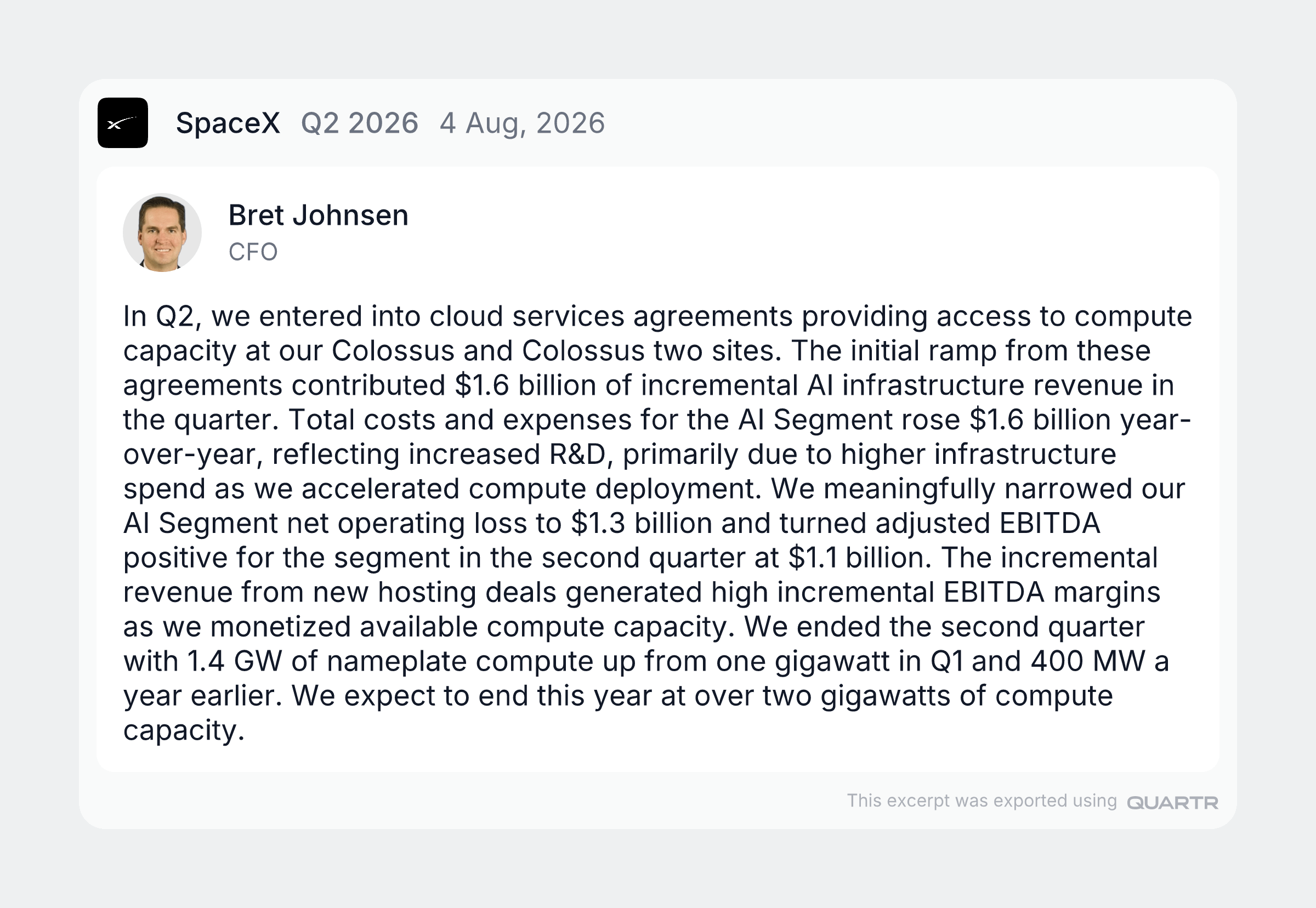
There is already a business behind the capacity expansion. SpaceX’s August earnings call described Colossus cloud-services agreements contributing revenue as customers gained access to compute. That historical operating context helps explain the scale of the proposed investment without turning the financing report into a completed chip purchase.
Details:
CFO Bret Johnsen said cloud services contributed $1.6 billion of incremental AI-infrastructure revenue in Q2.
Nameplate compute capacity ended Q2 at 1.4 GW, up from 1 GW in Q1. Nameplate capacity describes the installed capability cited by management; it is not a measure of utilized compute.
Johnsen also reported another $6.7 billion of contracted cloud-services revenue over a six-month period, with the ramp beginning in October. The contracted ramp begins after the Q2 results.
In August, Musk said SpaceX had decided to build exclusively on NVIDIA because he considered Vera Rubin the best AI architecture. That is his stated assessment and historical hardware decision.
Why AI/Semiconductor Investors Should Care: For customers who need outside funding, equipment that keeps earning across years and different workloads can give lenders more confidence. That operating history can influence hardware choice alongside performance. It is a financing thesis, rather than evidence that every NVIDIA system receives a better borrowing rate.
SpaceX’s reported plan puts the funding requirement into concrete numbers. The actual borrowing terms and closing will matter, alongside how the contracted cloud-services ramp develops. Those milestones connect the capital being sought to the compute capacity and revenue it is intended to support.
For educational and informational purposes. This newsletter is not investment advice. Do your own research before making investment decisions.