

Welcome, AI & Semiconductor Investors,
NVIDIA just absorbed the orchestration software running half the world’s supercomputers and dropped open models designed to power AI agent armies, pretty much vertical integration on steroids. Meanwhile, Micron’s about to report earnings into a memory market so tight that analysts are falling over themselves to slap $300 targets on the stock. The AI infrastructure buildout isn’t slowing down; it’s getting more concentrated. — Let’s Chip In.
What The Chip Happened?
🔧 NVIDIA Swallows the Supercomputer Scheduler and Promises to Play Nice
🤖 NVIDIA Goes Open-Source (But Keeps the GPU Moat Intact)
💾 Micron Earnings: Memory Shortage Meets Sky-High Expectations
Read time: 7 minutes
Join WhatTheChipHappened Community — 15% OFF Annual Use Code CHIPS
Get 15% OFF FISCAL.AI — ALL CHARTS ARE FROM FISCAL.AI —
NVIDIA Corporation (NASDAQ: NVDA)
🔧 NVIDIA Acquires SchedMD, the Software Powering Half the World’s Top Supercomputers
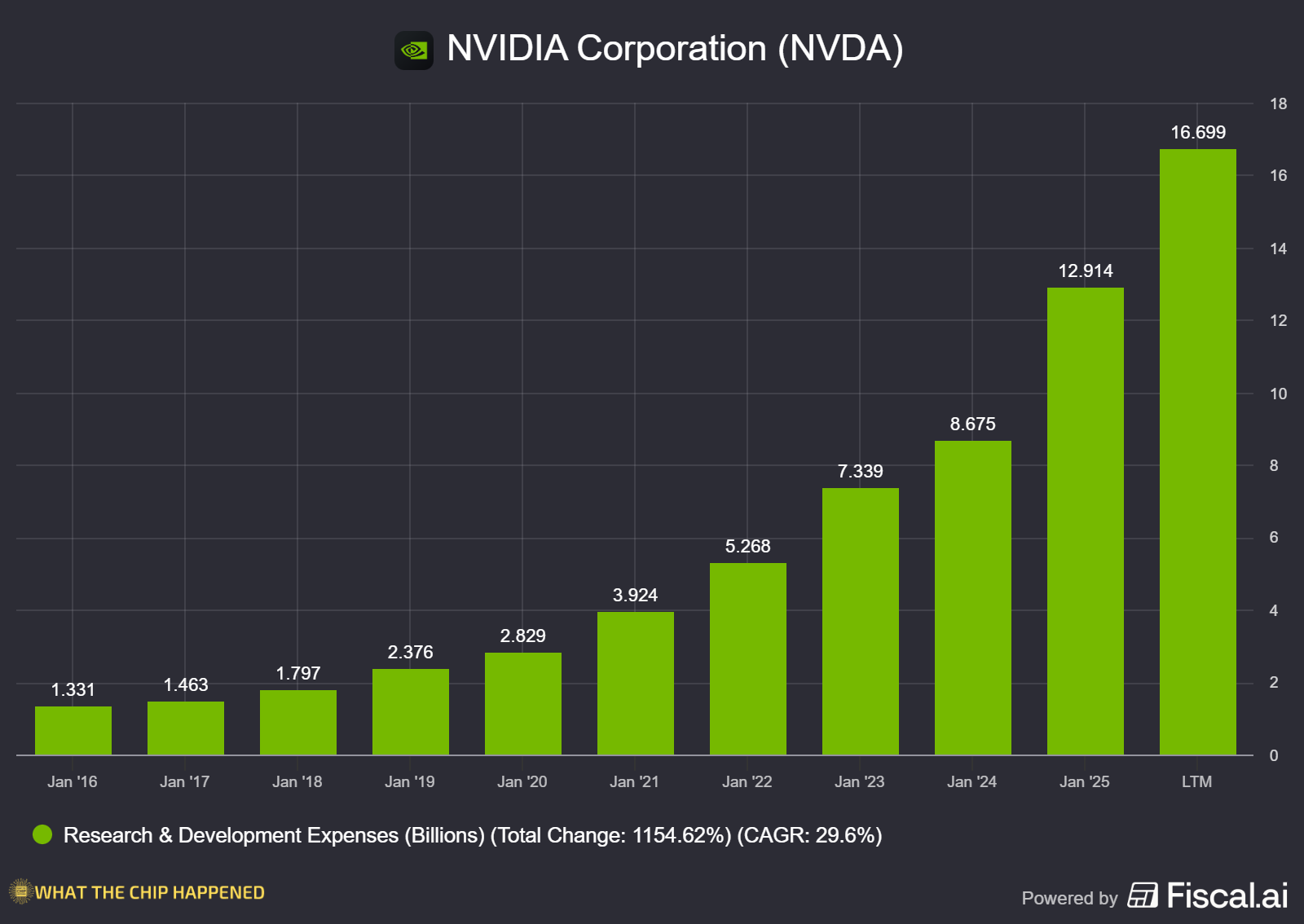
What The Chip: NVIDIA announced the acquisition of SchedMD, creator of Slurm, the open-source workload management system that orchestrates over half of the TOP500 supercomputers globally. This isn’t just another tuck-in acquisition; NVIDIA now controls the scheduling layer that determines how AI training and inference workloads run across massive compute clusters. The company committed to keeping Slurm open-source and vendor-neutral, but make no mistake: NVIDIA just grabbed the traffic controller for the world’s most powerful AI infrastructure.
Details:
🎯 Dominant Market Position: Slurm manages workloads on more than half of both the top 10 and top 100 supercomputers in the TOP500 list, making it the de facto standard for HPC and AI cluster orchestration. Making it a mission-critical infrastructure.
🤝 Decade in the Making: NVIDIA and SchedMD have collaborated for over 10 years, meaning this acquisition formalizes a relationship that already shaped how AI clusters operate. NVIDIA knows the codebase, the team, and the strategic leverage points.
🛡️ Open-Source Commitment (For Now): NVIDIA explicitly pledged to continue Slurm development as open-source, vendor-neutral software supporting heterogeneous hardware environments, not just NVIDIA GPUs.
🚀 AI Training Bottleneck Solved: As clusters scale to 100,000+ GPUs, efficient resource allocation becomes the difference between economical AI training and burning cash. Slurm excels at scalability, throughput, and complex policy management, the exact capabilities needed for foundation model development.
💼 Enterprise Customer Goldmine: SchedMD serves hundreds of customers spanning cloud providers, AI labs, autonomous driving companies, healthcare, energy, financial services, and government agencies. NVIDIA just inherited those relationships.
🔌 Vertical Integration Play: NVIDIA now controls critical layers across the AI stack: GPUs (hardware), CUDA (software framework), NeMo (training tools), and now Slurm (workload orchestration). Each layer reinforces the others, deepening customer lock-in.
🌍 Heterogeneous Support Maintains Ecosystem Buy-In: By continuing to support non-NVIDIA hardware, NVIDIA avoids immediate customer backlash and regulatory scrutiny. But over time, one might expect NVIDIA-specific optimizations that make Slurm work best on NVIDIA silicon.
Why AI/Semiconductor Investors Should Care: This is vertical integration disguised as an open-source play. NVIDIA now owns the orchestration layer that sits between AI workloads and compute hardware, giving it unparalleled leverage as clusters scale. The open-source commitment buys goodwill and avoids antitrust heat, but the strategic position is clear: NVIDIA controls more of the stack than ever. Watch whether competitors respond by backing alternative schedulers, and whether NVIDIA introduces “enterprise” features that fragment the open-source offering. If Slurm remains truly neutral, NVIDIA gains influence; if it tilts toward NVIDIA hardware, the company gains pricing power. Either way, this acquisition tightens NVIDIA’s grip on AI infrastructure at exactly the moment when orchestration complexity is exploding.
Join WhatTheChipHappened Community — 15% OFF Annual Use Code CHIPS
Get 15% OFF FISCAL.AI — ALL CHARTS ARE FROM FISCAL.AI —
NVIDIA Corporation (NASDAQ: NVDA)
🤖 NVIDIA Drops Nemotron 3: Open Models Built to Power the Agentic AI Era
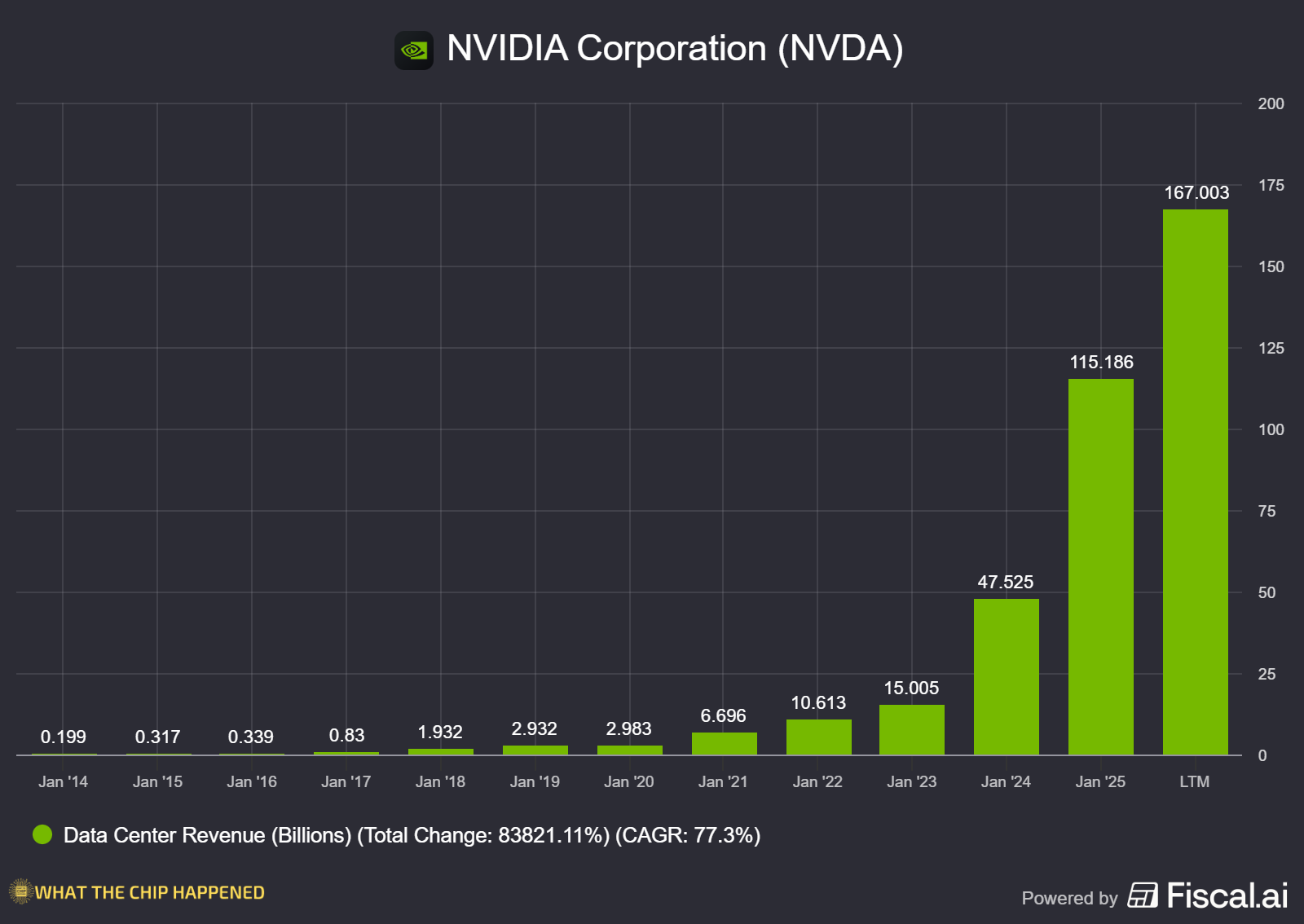
What The Chip: NVIDIA launched the Nemotron 3 model family, Nano, Super, and Ultra, designed specifically for multi-agent AI systems. These are open-source models, NVIDIA bundled training datasets (3 trillion tokens), reinforcement learning libraries (NeMo Gym, NeMo RL), safety tools, and enterprise deployment infrastructure. Early adopters, including Perplexity, ServiceNow, Palantir, CrowdStrike, and Accenture, are already integrating Nemotron as they develop specialized AI agents to automate complex enterprise workflows.
Details:
⚡ Architecture Breakthrough: Nemotron 3 uses a hybrid latent mixture-of-experts (MoE) design that activates only a fraction of total parameters per token: Nano (30B total/3B active), Super (~100B/10B active), Ultra (~500B/50B active). This delivers frontier-model performance at a fraction of the compute cost.
💰 4x Efficiency Gains: Nemotron 3 Nano delivers 4x higher token throughput versus Nemotron 2 Nano and reduces reasoning-token generation by up to 60%, directly attacking the inference cost problem that has plagued large-scale AI deployments.
🔮 1-Million-Token Context Window: The massive context window enables long-horizon, multistep agent workflows without context drift, critical for complex enterprise automation like multi-day project management, legal document analysis, or supply chain optimization.
⚛️ Training Innovation on Blackwell: Super and Ultra models leverage NVIDIA’s NVFP4 (4-bit floating-point) training format on Blackwell architecture, slashing memory requirements while maintaining accuracy parity with higher-precision formats. This is NVIDIA showing off Blackwell’s capabilities while making a case for hardware upgrades.
🌍 Open Ecosystem Play: NVIDIA released 3 trillion tokens of training data, open-source RL libraries, safety evaluation tools, and the Nemotron Agentic Safety Dataset. Nvidia is building dependency. Developers train on NVIDIA tools, deploy on NVIDIA infrastructure, and run inference on NVIDIA GPUs.
📈 Enterprise Adoption Wave: Early adopters span cybersecurity (CrowdStrike), EDA (Cadence, Synopsys), consulting (Accenture, Deloitte, EY), and workflow automation (ServiceNow, Zoom, Palantir). These aren’t startup companies, they’re production deployments signaling real enterprise demand for agentic AI.
🔌 Cloud Distribution Strategy: Nemotron models are coming to Amazon Bedrock, Google Cloud, Microsoft Azure Foundry, CoreWeave, and others, plus NIM microservices for on-prem deployment. NVIDIA is ensuring Nemotron runs everywhere customers want to deploy AI.
🛡️ Sovereign AI Alignment: Nemotron explicitly supports NVIDIA’s sovereign AI push, with adoption from Europe to South Korea for locally-controlled, regulation-compliant AI development. As governments demand domestic AI capabilities, NVIDIA provides the model layer.
🟢 Availability Timeline: Nano is available now on Hugging Face and via inference providers like Baseten, DeepInfra, Fireworks, and Together AI. Super and Ultra models expected H1 2026, conveniently timed with Blackwell volume production ramp.
Why AI/Semiconductor Investors Should Care: NVIDIA is building a moat around agentic AI before the category fully materializes. Open-sourcing models might seem like giving away the farm, but it’s actually a brilliant strategy: NVIDIA captures value at the hardware layer (GPUs for training and inference), the software layer (NeMo tools), and the services layer (NIM deployment). Every enterprise deploying Nemotron agents is a customer for NVIDIA compute. The real test is whether Super and Ultra deliver on time in H1 2026 and whether Nemotron becomes the default “efficiency model” in hybrid routing architectures, where agents switch between open models (Nemotron) for routine tasks and proprietary models (GPT, Claude) for complex reasoning. Watch enterprise adoption metrics, model performance benchmarks versus Meta’s Llama and Mistral, and whether hyperscalers launch competing open models to avoid NVIDIA dependency.
Join WhatTheChipHappened Community — 15% OFF Annual Use Code CHIPS
Get 15% OFF FISCAL.AI — ALL CHARTS ARE FROM FISCAL.AI —
Micron Technology (NASDAQ: MU)
💾 Micron Earnings: HBM Sold Out, Analysts Bullish, Expectations Sky-High
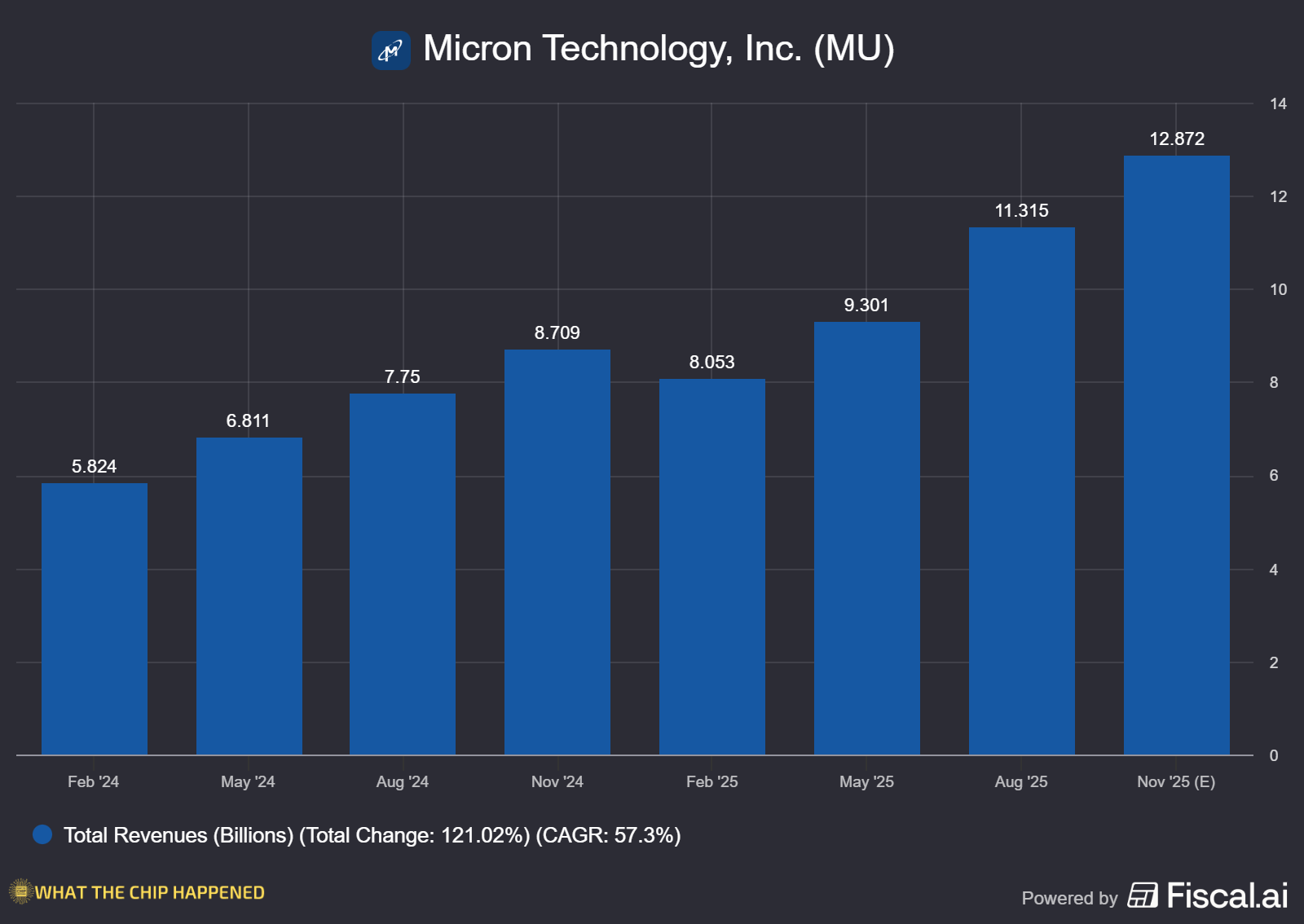
What The Chip: Micron reports fiscal Q1 2026 earnings after the bell on December 17, walking into a memory market so tight that TrendForce says supplier inventory has collapsed to two-to-four weeks and SK Hynix warns shortages could last through late 2027. The company’s own guidance calls for ~$12.5B revenue and $3.75 EPS, but Street consensus is clustering higher at $12.6B-$12.86B. Shares are up nearly 200% year-to-date as analysts pile into $300 price targets, framing Micron as the ultimate AI memory play. The setup is perfect, unless the company disappoints or guides cautiously.
Details:
💰 Revenue Beat Setup: Street consensus sits at $12.6B-$12.86B versus Micron’s ~$12.5B guidance, with Citi analyst seeing potential upside to $14B. Expectations are elevated but achievable given the supply environment and pricing power.
📈 EPS Expectations High: Consensus EPS forecast is $3.93-$3.94, implying strong margin expansion. Micron guided gross margin to ~51.5%, up from prior levels, reflecting the shift toward high-value HBM and AI-optimized DRAM.
🔥 HBM Revenue Surge: Fiscal Q4 HBM revenue hit nearly $2B, implying an annualized run rate near $8B. Micron expects to sell out its calendar 2026 HBM supply within months, with HBM3E pricing locked and HBM4 pricing expected to be “significantly higher.” This is pricing power in action.
🚩 Memory Shortage Intensifies: DRAM supplier inventory has collapsed to two-to-four weeks per TrendForce, down sharply from historical norms. SK Hynix commentary suggests shortages persist through late 2027, supporting sustained pricing power.
⚡ Pricing Environment Inflects: Counterpoint Research expects advanced and legacy memory prices to rise ~30% through Q4 2025 and potentially another ~20% in early 2026. Micron is riding a pricing wave that’s just getting started.
🎯 DRAM Market Share Gains: Micron’s DRAM market share increased 3.7 percentage points year-over-year in Q3 2025 to 25.7% per TrendForce. The company is gaining share while the market expands, a rare combination.
🛡️ Strategic Exit from Consumer: Micron announced it will exit the Crucial consumer memory business to improve supply allocation for higher-margin AI-driven data center customers. This signals management is prioritizing profitability over volume.
💡 Capex Ramp for HBM: Capex (net of incentives) is expected to exceed $18B in fiscal 2026, up from $13.8B in fiscal 2025. Micron plans to invest ~$9.6B in a Hiroshima, Japan facility for advanced HBM, with construction starting in 2026. The company is betting big on HBM capacity.
🟢 Analyst Upgrade Wave: Wedbush and Mizuho both lifted price targets to $300 on December 15. UBS moved to $295 from $275, citing stronger DRAM and NAND pricing. Wall Street is converging on the bullish case.
📊 Fiscal 2025 Context: Fiscal 2025 revenue grew nearly 50% to $37.4B, with gross margins expanding 17 percentage points to 41%. Fiscal 2026 consensus calls for $17.27 EPS—if Micron achieves that and trades at 25x earnings, stock price could hit $432 (71% upside potential).
Why AI/Semiconductor Investors Should Care: Micron sits at the intersection of genuine supply shortage, rapid AI-driven product mix improvement, and elevated market expectations. The bull case is straightforward: memory shortage + pricing power + HBM ramp = sustained earnings growth. At 15x forward earnings, the stock looks cheap if the memory supercycle plays out through 2026-2027. The bear case is equally simple: expectations are high after a near-tripling YTD, and any cautious guidance or competitive pressure (especially from SK Hynix in HBM) could trigger a sharp reversal.
Watch three things: (1) HBM revenue trajectory and whether management reconfirms selling out 2026 capacity; (2) DRAM/NAND pricing commentary and whether pricing momentum sustains into H1 2026; (3) competitive dynamics, especially Samsung’s HBM qualification progress with NVIDIA. If guidance disappoints, the stock’s stretched valuation multiples offer limited downside protection. This earnings print will either validate or deflate the AI memory supercycle thesis, there’s no middle ground.
Youtube Channel - Jose Najarro Stocks
X Account - @_Josenajarro
Join WhatTheChipHappened Community — 15% OFF Annual Use Code CHIPS
Get 15% OFF FISCAL.AI — ALL CHARTS ARE FROM FISCAL.AI —
Disclaimer: This article is intended for educational and informational purposes only and should not be construed as investment advice. Always conduct your own research and consult with a qualified financial advisor before making any investment decisions.