

NVIDIA (NVDA) reports Q2 fiscal 2027 on Wednesday, August 26, after the close. The revenue bar is known, the guide is known, and Vera Rubin’s first shipments land in the quarter they are about to guide. The week’s news added two more threads: reported 15%-plus price increases on 2027 AI server systems, and $6 billion to put NVIDIA’s flag on the open-weight model race. But what I think deserves the most attention is the commitments, on both sides of the balance sheet, which have gone from footnote to the defining feature of how this company operates in three quarters.
What the Street expects, and what NVIDIA already promised
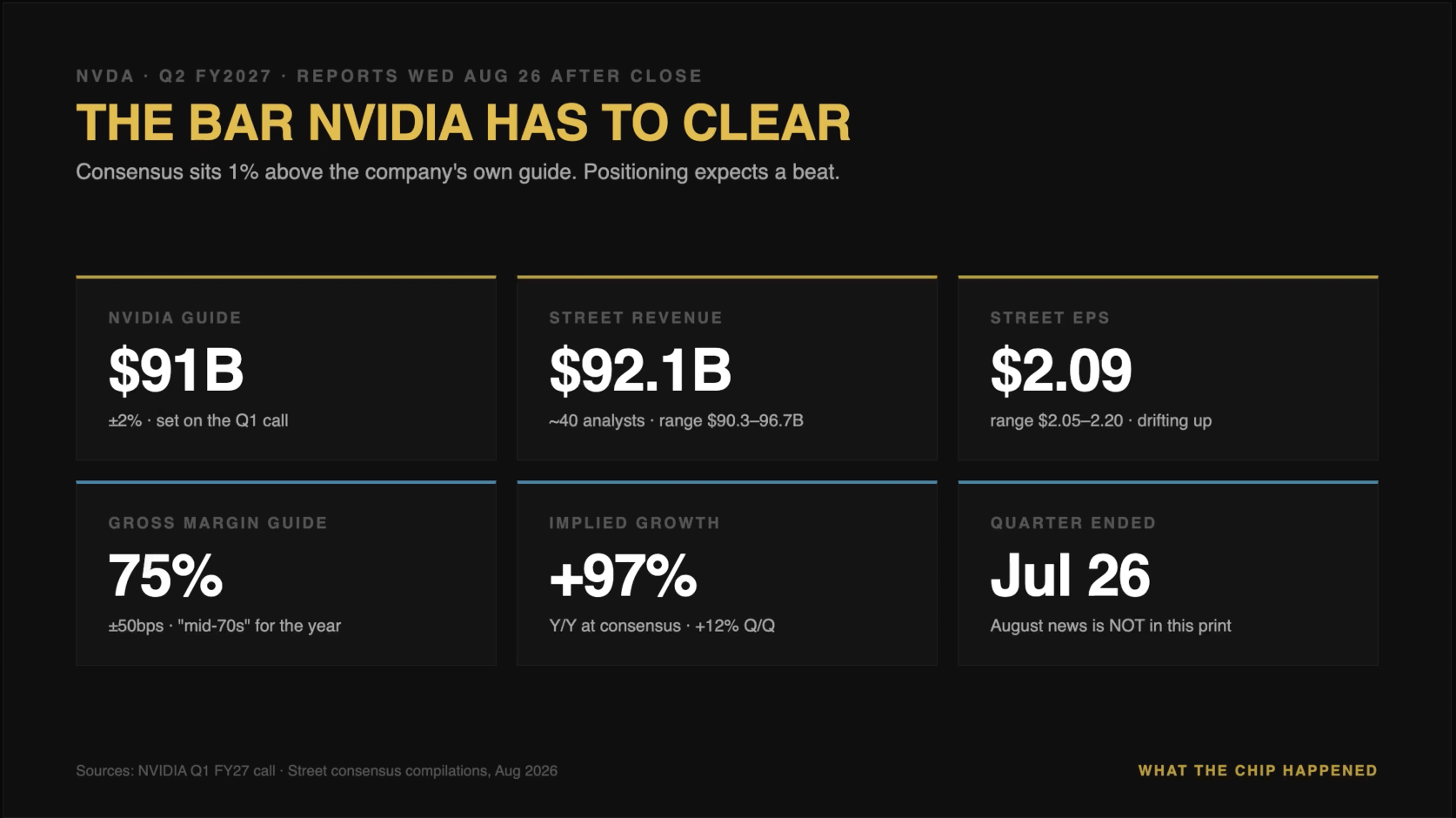
Management guided Q2 to $91 billion, plus or minus 2%, with GAAP gross margin of 74.9% and non-GAAP of 75%, plus or minus 50 basis points, and mid-70s gross margin for the full year. Consensus sits just above the midpoint: roughly $92 billion in revenue and $2.09 in EPS across about forty analysts, with the ranges running $90.3 to $96.7 billion and $2.05 to $2.20. In other words, the Street thinks the guide is slightly conservative and no more. Estimates have drifted up about half a percent over the past month.
A quick note before the rest of this. If you want to go deeper than the free posts, the community is where the real work lives. Multiple exclusive live streams every week. Earnings deep dives. The AI apps I build for research. Numerous conference coverage, and more are added all the time. You can join at [whatthechiphappened.com].
Run the growth math on the consensus number. Ninety-two billion would be up roughly 97% from the year-ago quarter and 12% sequentially, on top of a Q1 that grew 85% and set a $13.5 billion sequential record. Within that, analysts expect data center revenue potentially reaching $80 billion or more, against $75.2 billion in Q1, which itself was up 92% from a year earlier, with compute at $60 billion and networking at $15 billion after nearly tripling.
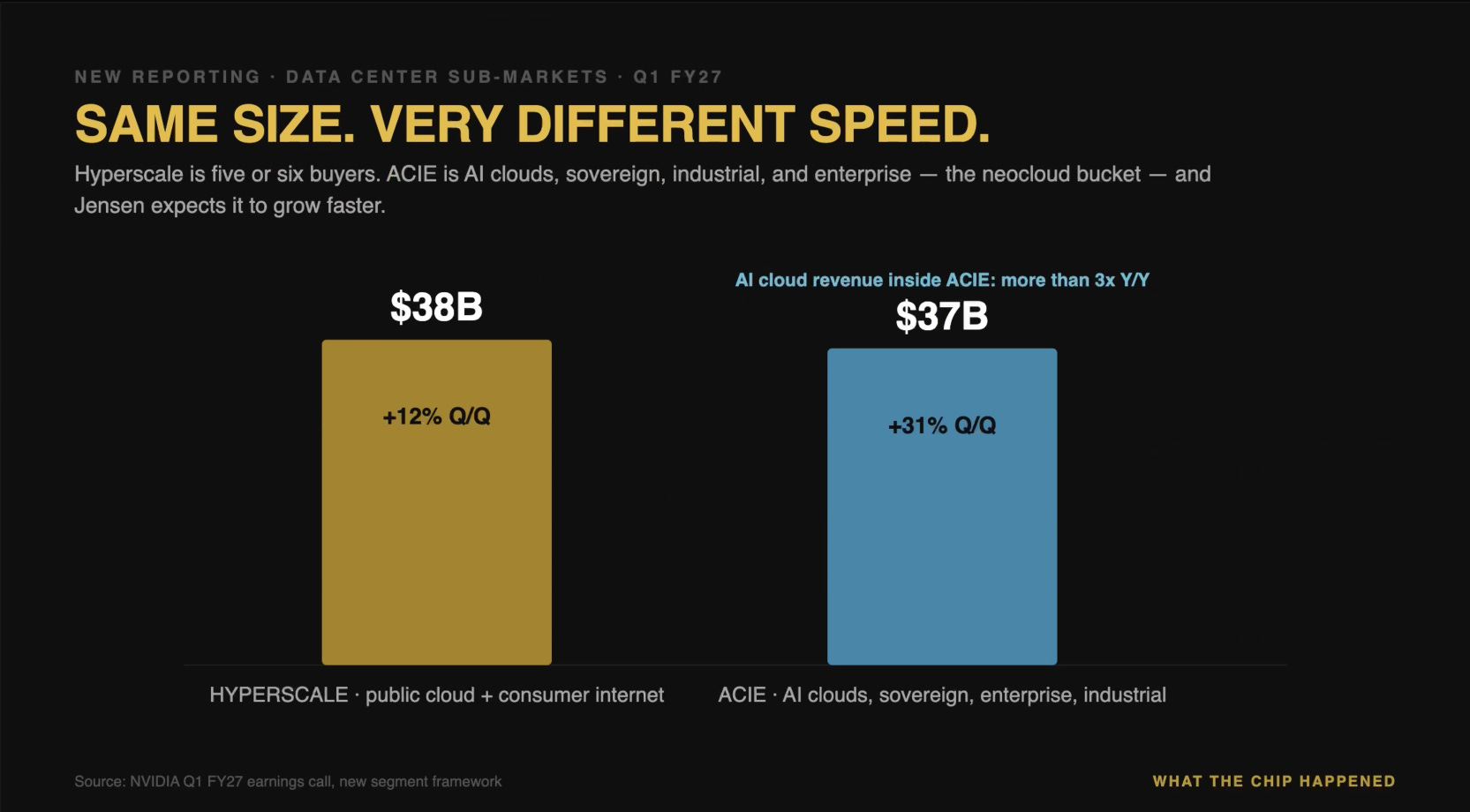
Remember the new reporting structure from last quarter, because comparisons now run through it. NVIDIA reports Data Center in two halves. Hyperscale was $38 billion in Q1, up 12% sequentially. ACIE, which is AI clouds, industrial, and enterprise, was $37 billion, up 31% sequentially, with AI cloud revenue more than tripling year over year. Edge Computing, the third bucket, did $6.4 billion. The split to watch is Hyperscale against ACIE. They are the same size today and growing at very different speeds, and Jensen said plainly last quarter that he expects the second category to grow faster. That is the neocloud, sovereign, and enterprise bucket, which is exactly where my coverage lives.
What the company said last quarter, and what analysts kept pushing on
The Q1 call had a clear shape. Colette’s prepared remarks carried the demand case: a third straight quarter of year-over-year acceleration, an inflection in inference, sovereign revenue up more than 80%, partner data centers above 10 megawatts doubling in a year to more than 80 sites, and hyperscale capex forecast by the Street to pass $1 trillion in 2027 on the way to what management frames as $3 to $4 trillion in annual AI infrastructure spend by the end of the decade. The two most quotable commitments were the $1 trillion in expected Blackwell plus Rubin revenue from 2025 through calendar 2027, reaffirmed with “full confidence,” and Jensen closing the call with “demand has gone parabolic.”
Two data points from that call matter directly to theses I have written about here. First, Colette cited rising rental pricing on old silicon, with H100 cloud pricing up 20% year to date and A100 up nearly 15%, and said customers are “generating profitable revenue beyond the depreciable life of their GPUs.” That is the depreciation bear case being dismantled by the vendor’s own disclosure, the same argument the CoreWeave A100-to-2029 contract made from the buyer side. Second, she called NVIDIA compute “the most economic and financiable” infrastructure, which tells you the company knows financeability is a moat and is now marketing it.
The Q&A concentrated on five things, and I would expect every one of them to come back Wednesday. One, the new segmentation and where neoclouds sit, which is ACIE. Two, whether NVIDIA should grow faster than hyperscaler capex. Jensen’s answer was yes, because the second category buys full systems and semi-custom chips do not apply there. Three, inference share, where the answer leaned on Anthropic: NVIDIA’s coverage of Anthropic “has been largely zero until just recently,” and capacity is now being stood up for them across Azure, AWS, and CoreWeave. Four, the Vera CPU, a standalone $200 billion TAM with visibility to nearly $20 billion in CPU revenue this year, excluded from the $1 trillion visibility number. Five, the Vera Rubin ramp: production shipments start in Q3, ramp through Q4, with Q1 of next year “very big.” Every frontier model company is expected on Vera Rubin from the start, which was not true of Blackwell.
That last one sets up this print. The quarter NVIDIA is about to guide is the quarter Vera Rubin revenue begins. I have written that Vera Rubin is going to be a beast, and that it is already margin-accretive from day one at CoreWeave before the ramp even starts. The Q3 guide is where that thesis meets a number.
The commitments story, in both directions
Here is the part I think deserves the most attention, because the scale changed faster than the narrative did.
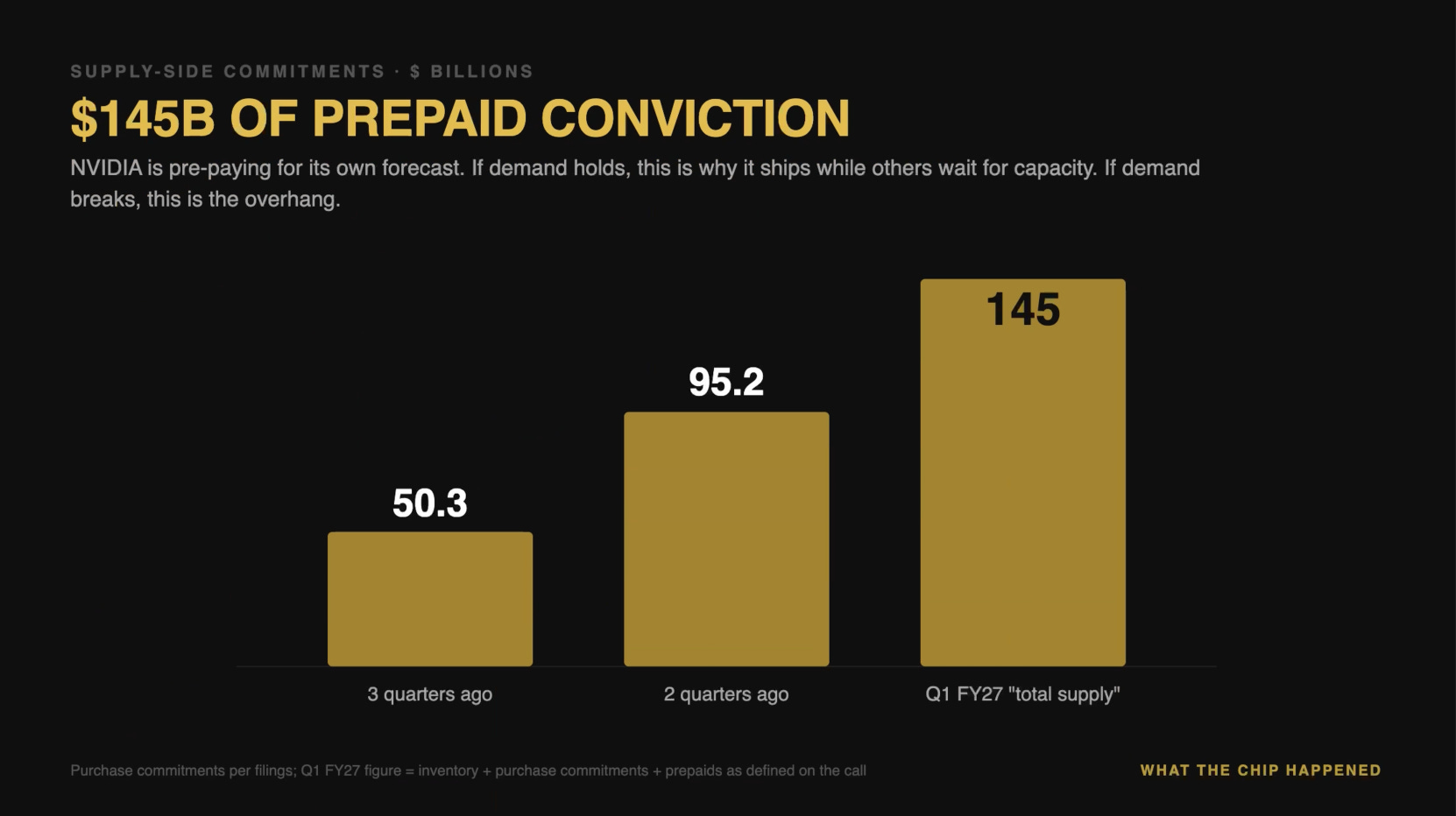
Commitments run in two directions at NVIDIA. The first direction is supply. NVIDIA commits capital to its suppliers to lock manufacturing capacity, materials, and components years ahead. Three quarters ago, supply-related purchase commitments stood at roughly $50 billion. A quarter later they nearly doubled to about $95 billion. Last quarter, Colette reported total supply, which is inventory plus purchase commitments plus prepaids, at $145 billion. That is a company pre-paying for its own forecast. If demand disappoints, that number becomes the overhang. If demand holds, it is the reason NVIDIA ships while others wait for capacity.
The second direction is customers, and this is where the style evolved quarter by quarter. Watch the progression.
It started with offtake backstops. NVIDIA guaranteeing portions of neocloud GPU rental agreements so lenders would finance the clusters. Useful, but modest in size, and I wrote at the time that it was mostly a bull signal with a Lucent-shaped risk worth monitoring, not dismissing. AMD runs similar arrangements, which told you it was industry practice rather than one company propping up its numbers.
Then came equity. NVIDIA put $10 billion into xAI in January, which converted into a SpaceX stake now disclosed at roughly $21 billion after the merger. The $5 billion Intel position is now worth somewhere north of $20 billion. Reported totals for NVIDIA’s equity investments across OpenAI, Anthropic, and others run from $40 billion to as much as $70 billion depending on whose accounting you take. The 13F disclosures this month were the public look at some of these, and they are the size of a large fund.
Then came the financing platforms. This month NVIDIA announced partnerships with Apollo, BlackRock, Blackstone, Brookfield, Goldman Sachs, and KKR to mobilize over $500 billion of third-party capital for AI infrastructure. NVIDIA’s own exposure is deliberately capped, a residual-value support mechanism for up to 25% of an opportunity, which the company itself describes as substantially lower than other compute-financing arrangements. The structure is designed to not be vendor financing in the Lucent sense. Six institutional balance sheets underwrite independently; NVIDIA backstops a slice.
And then came LPS, land, power, and shell, which is the new frontier. At the PORTS-Pike campus in Ohio, with SB Energy building and OpenAI as anchor tenant on roughly 12 gigawatts, NVIDIA is reported to be providing up to $105 billion in financing support for a single customer’s site, alongside a $1.5 billion investment in SB Energy and guarantees on lease and power payments over a 20-year term. Read that sequence again. Two years ago the commitments discussion was a few billion of offtake backstops. Today there is a reported eleven-figure backstop attached to one customer at one campus.
Why do it? My read is the term. Twenty years is a land duration, not a chip duration, and no GPU generation lives that long. NVIDIA is not underwriting OpenAI so much as buying a two-decade option on the scarce input. If the anchor tenant stumbles, NVIDIA controls a powered site and the next tenant fills it with NVIDIA racks. The honest risk is cost of carry through a vacancy, and the falsifier I keep on file is a failed anchor that does not re-tenant. And the reason the OpenAI concentration does not scare me is the same one I wrote about to my community: if one lab slows, the demand transfers to whoever is winning. NVIDIA supplies both sides of that transfer, and it said as much last quarter when Colette named breakout growth at both Anthropic and OpenAI in the same sentence.
What I want from Wednesday’s call on this topic is simple. An updated total supply number, any disclosure quantifying the aggregate customer-side guarantees, and language about how management thinks about the ceiling. The 10-Q commitments note will be the most important page of the filing.
The August 22 report: AI server prices up 15% or more
This is genuinely new news walking into the call. Bloomberg reported that some of NVIDIA’s largest customers have been told prices for AI server systems will rise more than 15% in many configurations, beginning with systems shipping in early 2027, affecting both Grace Blackwell and Vera Rubin systems and varying by generation and memory configuration. Reuters carried the story but said it had not independently verified it. The Information put a sharper number on it: roughly 17% for some GB300 and Vera Rubin 200 systems, and an estimate that the increase could add at least $5 billion to the hardware cost of a single 1-gigawatt AI data center.
The reason is memory, not NVIDIA deciding to expand margins by fiat. DRAM has gotten expensive enough that the contract server builders serving Microsoft, Google, and Oracle are passing costs through, and the reporting specifically points at the bargaining power of SK Hynix, Micron (MU), and Samsung as AI consumes enormous quantities of memory.
Three implications, in order of how much I trust them.
First, demand is strong enough to carry the increase. NVIDIA is not absorbing the memory hit to protect volumes; the whole chain is preparing to pass higher prices into 2027. Suppliers do not do that unless they believe the market bears it. This is the same mechanism CoreWeave described in Q2, raising prices roughly 25% while explicitly passing through component costs, now confirmed at the system level.
Second, do not model 15 to 17% as NVIDIA revenue or gross profit. A meaningful share is pass-through of more expensive memory and components. The bullish read is that NVIDIA preserves its economics despite a rising bill of materials, not that margins jump 15%. Watch the mid-70s gross margin language on the call; holding it through both an architecture transition and memory inflation would be the actual statement.
Third, the cleanest read-through might be memory itself. If NVIDIA, the most powerful buyer in AI hardware, cannot force memory pricing down enough to prevent a major system-price increase, that says everything about how tight DRAM is. SK Hynix, Micron, and Samsung have real leverage right now. I have been on the memory-inflation thesis since the Microsoft and Amazon prints, and this is the strongest confirmation yet from the buying side.
The risk is straightforward and it belongs in the risk column, not the base case: there is a point where increasingly expensive AI factories hurt customer ROI, and 15% on multibillion-dollar projects is not trivial. On Wednesday’s call, the thing to listen for is whether customers are accepting 2027 pricing without pushing deployments out.
The Poolside deal: NVIDIA is buying the open-weight flag
The Wall Street Journal reported that NVIDIA is paying roughly $6 billion to license Poolside’s model-development technology, with more than 100 Poolside engineers joining NVIDIA’s model effort, plus a separate reported $1 billion investment at a $12 billion valuation. It is explicitly not an acquisition; Poolside keeps operating independently. The objective is to accelerate NVIDIA’s Nemotron family into one of the strongest open-weight model platforms in the world.
Quick context on Poolside, since it is not a household name. It is an American lab focused on agentic software engineering, models that autonomously write, debug, and modify code rather than autocomplete it. Its Laguna family ships as open-weight models: Laguna S is a 118-billion-parameter mixture-of-experts design with only about 8 billion parameters active and a 1-million-token context window, and there is a smaller version compact enough to run locally. Coding, agentic, open-weight. Those three words are the whole strategic logic.
Here is why I think this story is bigger than the headline. The open-weight race has been drifting toward China. DeepSeek, Kimi, and the Qwen family have become genuinely competitive while being downloadable and cheap to deploy, and enterprises increasingly want customizable models they can run themselves instead of paying frontier API prices forever. If the dominant open-weight platform becomes Chinese, the developers building on it have every incentive to optimize for Huawei and domestic accelerators over time. A strong American open-weight platform keeps that enormous workload CUDA-native. Jensen has been unusually vocal on exactly this point, arguing publicly that open models increase demand for chips and data centers.
Read it through the framework I keep coming back to. NVIDIA does not have to predict the winning model company. If OpenAI wins, NVIDIA wins. If Anthropic wins, NVIDIA wins. If open models win, NVIDIA now wants Nemotron to be the open model that wins, so NVIDIA still wins. And if enterprises decide they do not need frontier intelligence for every workload and deploy cheaper specialized open models instead, NVIDIA does not want that shift to reduce GPU demand. It should do the opposite: a company that downloads an open model, fine-tunes it on internal data, and runs its own inference suddenly needs its own NVIDIA infrastructure. NVIDIA never has to monetize the model. The model is a demand-generation tool for the compute.
There is a tension worth naming honestly. NVIDIA is now, in a sense, competing with its own customers: Microsoft builds models, Google has Gemini, Amazon has Nova, Meta has its models, OpenAI is exploring its own silicon. Nemotron has to be positioned as an open foundation anyone can customize and deploy, not as NVIDIA’s chatbot. That is a delicate line, and how management talks about it matters.
What I am watching, in order
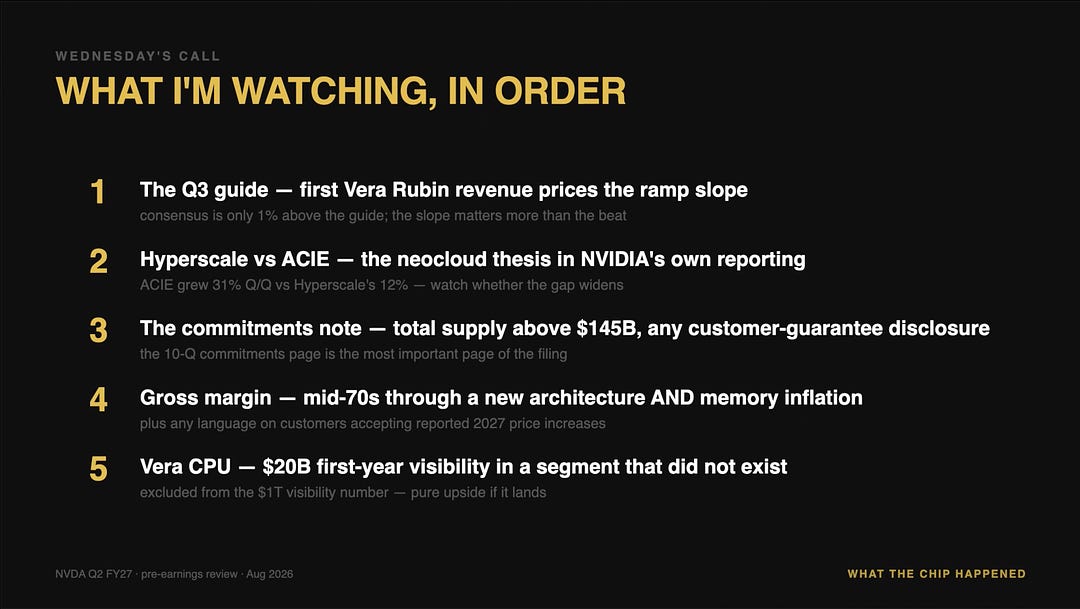
The Q3 guide first, because it contains the first Vera Rubin revenue and the market will price the slope of the ramp before anything else. The Hyperscale versus ACIE split second, because the thesis that the second category grows faster is the neocloud thesis wearing NVIDIA’s reporting structure. The commitments disclosures third, for the trend I laid out above. Gross margin fourth, and it now carries double weight: mid-70s through a full architecture transition AND memory inflation would be its own statement, and any commentary on customers accepting the reported 2027 price increases is the demand signal underneath it. And fifth, anything on the Vera standalone CPU, because $20 billion of first-year visibility in a segment that did not exist last year is the kind of number that gets lost under a $91 billion headline.
The bar is high. The guide implies roughly doubling year over year at a scale no company has ever done it, and consensus is only 1% above the guide, which tells you positioning expects a beat. What history says is that the size of the beat matters less than the tone on supply, and the company already told us where its confidence lives: $145 billion of it, prepaid.
If this is how you like to read the market, the rest is inside.
Most of the research I do never makes it to the free list. The full earnings and conference breakdowns, the companies I am tracking across chips, memory, equipment, and AI infrastructure, and the analysis I use to make my own decisions all live in the What The Chip Happened community. It is built for people who take semiconductor investing seriously and want the work done.
Join here: whatthechiphappened.com
This content is for informational and educational purposes only and is not financial advice. I am not a licensed financial advisor. Nothing here is a recommendation to buy or sell any security. I may hold positions in the companies mentioned. Do your own research and consult a qualified professional before making any investment decision.